On Saturday I donned my mask and visited Nottingham Contemporary for the first time since before the lockdown. The exhibition left me feeling more inspired than I have done in months. This is probably due to the fact that the pandemic has made any opportunity to leave the house seem so much more meaningful, paired with the fact that I am already in love with Grace Jones, this was the perfect recipe to drag me out of the creative rut I’ve felt stuck in during this crazy time and has reignited a spark of obsession which I haven’t experienced in a long time.
Part of the exhibition which really piqued my interest was the work of photographer and graphic designer, Jean-Paul Goude. Goude & Jones’ were romantic and creative partners between 1977 and 1984. The pair met through the New York disco scene and Goude soon began to take on the production of artwork for Jones’ album covers as well as stage managing her live shows.
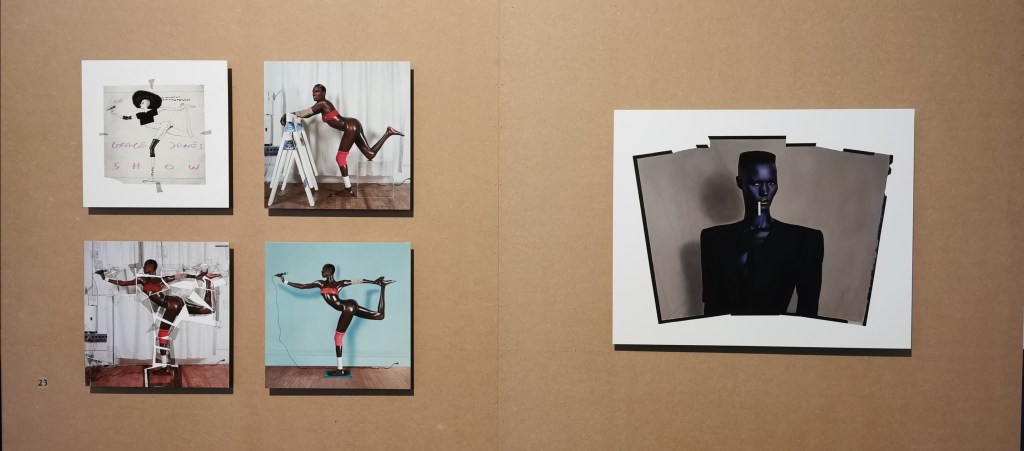
The exhibition displayed the development behind the iconic Island Life album artwork in which, Grace Jones is presented in an impossible position. Her limbs have been artificially extended by cutting up the original photograph, spreading the pieces and painting over the gaps. Her skin has been darkened and given an unrealistic sheen as if she is made from PVC. The same method is used for the album artwork for Nightclubbing. Here, Grace’s angular features are accentuated, contributing to her androgynous and intimidating aesthetic and persona.
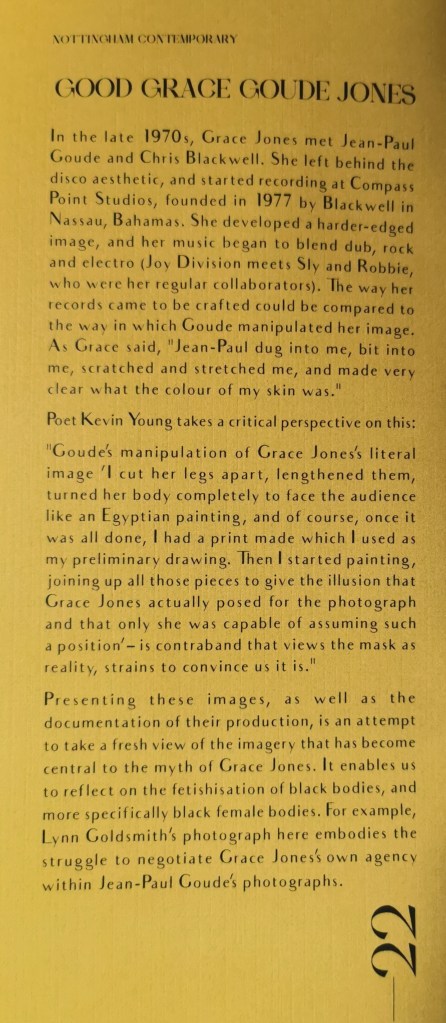
During the time the couple collaborated, Jones’ music began to steer away from disco and instead incorporate the darker sounds of post-punk blended with new wave and dub reggae. Goude’s surreal, distorted, and darkened depictions of Grace reflect this change of direction sonically but also reflect a more sinister side to his work which cannot go unchallenged in the era of the Black Lives Matter movement. I am of course, referring to the fetishization of black and female bodies which underpins so much of Goude’s work. Goude regularly exaggerates features of gender and race through a white male gaze which makes his work as controversial as it is visually stunning. The exhibition catalogue highlights this issue including a quote from Grace Jones herself about her work with Goude. “Jean-Paul dug into me, bit into me, scratched and stretched me, and made very clear what the colour of my skin was.”
2014 – Goude Breaks The Internet
In the age of the social media influencer we are bombarded constantly with images of unrealistically proportioned bodies. This has pushed a standard of beauty which is impossible to achieve without some form of editing, be it digitally editing or surgically editing. The line between real and fake is obscured through our screens.
The phenomenon of blackfishing highlights just how much the black female form specifically has become fetishized in our culture. Black women’s physical features such as skin tones, body shapes, lips, and hairstyles, are being co-opted by non-black people for fashion. This is despite black women still facing discrimination for the very features that have become so fashionable.
One controversial celebrity who has been accused of perpetuating this worrying trend on many occasions is Kim Kardashian. Back in 2014, Jean-Paul Goude photographed Kim Kardashian nude for the winter cover of Paper Magazine. This shoot would be remembered as the post that would #breaktheinternet.
The nude images stirred up a media frenzy and there was much debate over the extent to which the images were photoshopped. There is a clear resemblance in these shots to the shimmering skin and unrealistic proportions and positions Goude created for Grace Jones’ artwork. Goude’s 1976 portrait “Carolina Beaumont” was the direct inspiration for the cover shot of Kim popping a bottle of champagne into a glass balanced on her behind. The photograph was included in Goude’s questionably titled book, “Jungle Fever.” Another clear demonstration of the way Goude perceives the bodies of black women.
In a 2014 article for BBC Trending, African-American writer, and cultural critic, Mikki Kendall states that the popularity of Kardashian’s image shows how “black” body features are often more acceptable on white women. “The Kim Kardashian cover is the latest example of how racial double standards around nudity are enforced, as well as a prime example of how often women who do pose nude for art are attacked while the artists are absolved,”.
Even more worryingly, Goude’s photographs of Kim have been compared by some to Saartjie Baartman, a Khoisan woman who was forced to perform to audiences throughout Europe as the “Hottentot Venus” in the early 19th century on account of her . She is known as worldwide symbol of racism, colonization, and the objectification of the black female body.
 Jemima's Designs - Blog